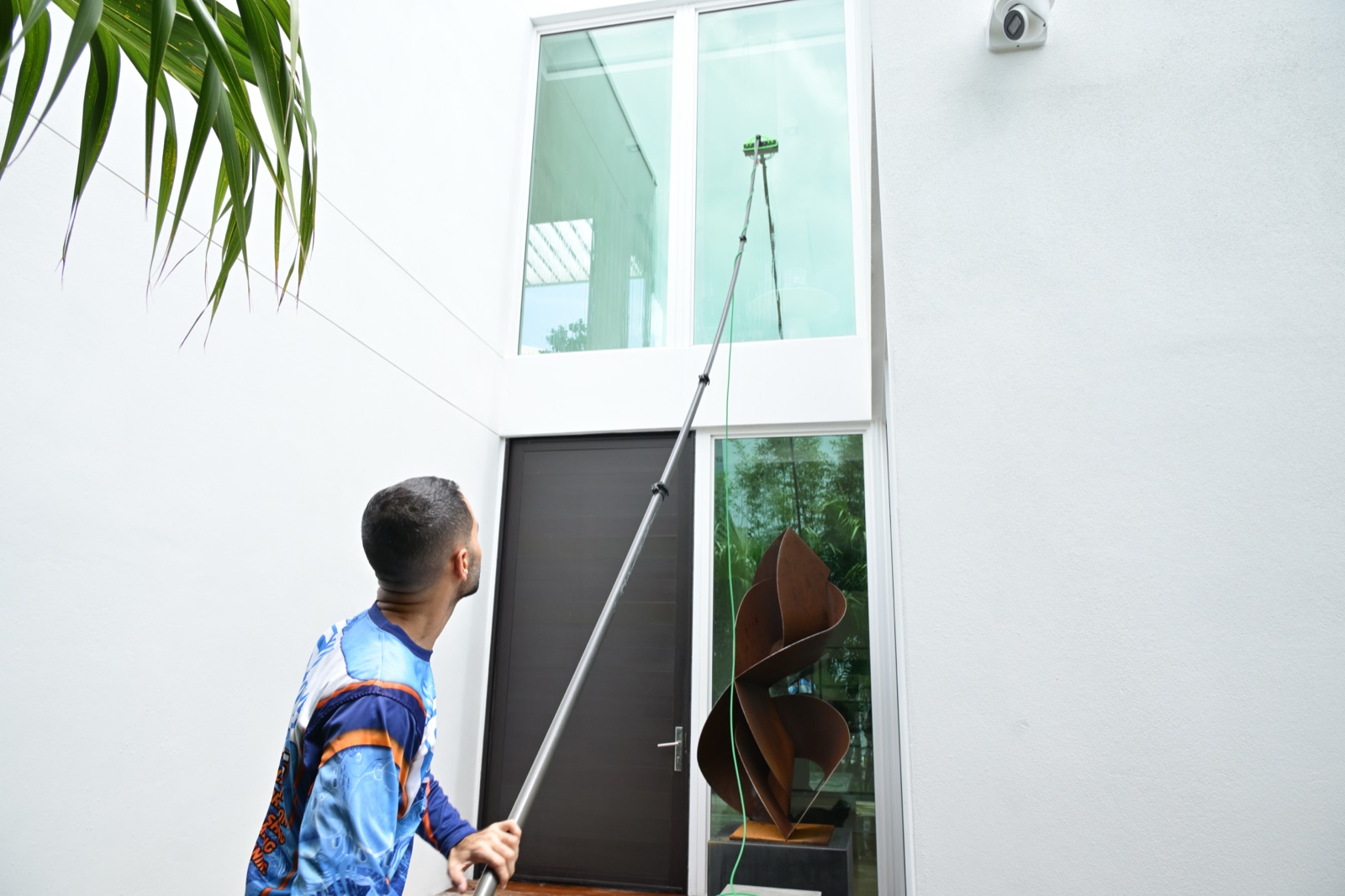
Construction cleanup is tricky. A lot of GCs and construction companies in Miami think they can save money by handing the post-construction window cleaning to a maid service or a generalist cleaner. The math feels right at the time. Two days later, when the buyer does the walk-through or the punch-list inspector pulls out a flashlight, the same crew is staring at scratched sliding doors and a row of high-end impact windows that need to be replaced.
That call gets made every week in South Florida. We've taken over enough of these projects to recognize the pattern by now.
This is what actually happens to glass during a build, what the wrong cleaner does to it, and what real post-construction window cleaning looks like in Miami-Dade and Broward.
What construction actually does to glass
Window glass on a job site lives through a lot. While the trades work around it, the surface picks up:
- Cement and stucco splatter. The worst one. The calcium in cement and stucco is highly alkaline and reacts chemically with glass. If it sits for weeks, it doesn't just sit on top, it starts to bond and etch.
- Silicone smears. Caulking crews finish a window install with a wipe and miss spots. Silicone cures hard and clear, and only the right solvent takes it off. Wrong solvent and it smears worse.
- Paint overspray. Spray painters tape and cover, then they don't, and you end up with a fine mist of paint on every pane within 30 feet of the work.
- Adhesive and sticker residue. Manufacturer stickers, blue tape, protective film. Pull them off late and the adhesive cures into the glass.
- Stucco runoff. When stucco crews wash their tools, the runoff hits the glass on the way down and sits there.
- Drywall mud spatter. The little white dots from a finishing pass. Looks like nothing until late afternoon when the sun comes in low and lights them up.
- Hurricane prep adhesive. If the build crossed storm season, you might be cleaning storm panel adhesive on top of everything else.
The longer this load sits, the deeper it bonds. Six weeks on a finished pane is not the same as six days. By the time someone notices it during the final walk, parts of the damage can already be permanent.
Why the wrong cleaner makes it worse
Generalist cleaning companies and maid services don't work on construction debris because they were never trained on it. They show up with the same products they use on bathroom mirrors and kitchen splashbacks. That's where the damage starts.
What goes wrong:
- Dry scraping. Running a razor blade across dry glass with cement dust still on it is the single fastest way to scratch a pane. The dust acts as an abrasive between the blade and the glass. You can hear it as it happens. By the time the crew notices, every pane on that elevation has parallel scratch lines.
- Used razor blades. A blade that ran across a previous job picks up tiny nicks. Those nicks then cut grooves into your glass. A new, fresh blade per pane is the rule. Generalist cleaners reuse.
- Wrong scrubber. Standard scouring pads, the green kitchen ones, are loaded with mineral abrasive. They scratch glass instantly. Bronze wool and #0000 steel wool look similar but behave completely differently when wet.
- Wrong solvent on Low-E coating. Modern impact windows in Miami almost always have Low-E or other low-emissivity coatings on one face. Acetone, ammonia, or aggressive solvents can strip that coating off. The window stops being energy efficient, the manufacturer warranty voids, and the damage isn't visually obvious until after the cleaner is gone.
- Pressure washing. Some crews bring a pressure washer to "save time." Pressure water drives construction debris into the seals and pushes water past the gasket into the wall behind the frame. The damage is invisible until the next rain. We covered the full breakdown of that one in our never pressure wash your windows piece.
The cost difference between the cheap cleaner and the right one on a single project is usually a few hundred dollars. The cost of replacing scratched impact glass on a Brickell high-rise is five figures per opening. The math is brutal as soon as one pane goes wrong.
Replacing a scratched impact pane on a Brickell or Sunny Isles high-rise can run five figures per opening, plus a 90-day reorder. That's all the math a GC needs.
Prevention starts at framing, not at the punch list
The cleanest post-construction window cleaning happens when the windows were protected during the build. Two methods work in South Florida:
- Blue Max or similar blue protective film applied before the trades enter. Peels off cleanly at the end of the project. Pricier, but worth it on high-end residential and Class A commercial.
- 6-mil plastic and tape. Cheaper, has to be replaced if it gets torn or soaked, but works on most residential builds.
If you're the GC and the windows weren't covered, you're playing defense. The cleaning gets slower, more expensive, and more careful. The cleaner has to be more deliberate, the products have to be stronger, and the time per pane climbs. That's the math the cheap-cleaner approach already lost before the truck pulled up.
What proper post-construction window cleaning actually looks like
This is the process used on every Shiny Windows post-construction job in Miami-Dade and Broward:
Step 1. Inspect before touching anything. Walk the job, identify what's on the glass (cement vs. silicone vs. paint vs. adhesive), and document any existing scratches that predate the cleaning. Photos. Time-stamped. Otherwise the cleaner gets blamed for damage they didn't cause.
Step 2. Soak before any blade comes near. Glass is fully wet with a soap solution before any razor work begins. The soap acts as a lubricant and floats the debris off the surface so the blade isn't grinding it back in.
Step 3. Fresh razor per elevation. A new blade for each elevation, sometimes per pane on heavily contaminated jobs. The blade goes in at the right angle (around 30 degrees), with light pressure, in one direction only. Never back and forth.
Step 4. Bronze wool or #0000 for the rest. Whatever the blade can't get, bronze wool or quad-zero steel wool with a soap film handles. Both are fine enough not to scratch tempered or Low-E coated glass when used wet on a properly wetted surface.
Step 5. Targeted solvents, tested first. Silicone gets a silicone-safe solvent. Adhesive gets a citrus-based dissolver. Paint overspray gets a glass-safe paint remover. Each in its place, and each tested on a hidden corner first to confirm it doesn't react with the coating on that specific window.
Step 6. Pure-water rinse. RO/DI water through a water-fed pole or hand-applied for the final pass. Pure water leaves nothing behind, no soap residue, no spots, no streaks. The full system explanation is in our RO/DI water-fed pole post.
Step 7. Final inspection in raking light. Walk the elevations at sunset or with a focused work light at a low angle. Scratches and missed spots only show at low angles. If something's still there, fix it before signoff, not after.
Where this matters most in South Florida
A few real examples of where post-construction work makes or breaks a project in our market:
- High-rise condos in Brickell, Edgewater, Downtown, and Sunny Isles. Floor-to-ceiling glass, Low-E impact coatings, scaffolding or rope access on the exterior. One scratched panel can mean a 90-day reorder and a punch-list slip that pushes closing.
- Custom homes in Coral Gables, Pinecrest, and Coconut Grove. Big sliders, custom-cut glass, tight punch-list windows from the buyer. Mistakes here delay closing.
- Class A office buildings in Doral, Aventura, and Miami Lakes. Tenant-improvement turnovers where the lease starts on a fixed date. The clean has to be perfect on the first try.
- Hotel and resort buildouts in Miami Beach, Bal Harbour, and Sunny Isles. Salt air during construction adds a layer on top of normal construction debris. The clean has to address both at once.
Post-construction work falls under our commercial service for buildings and tenant improvements, and our exterior service on the residential side. For interior glass detail (mirrors, shower enclosures, glass railings) the interior service handles what water-fed poles can't reach.
What I tell GCs at the bid stage
Three things, every time:
- Cover the windows during construction. Blue Max or 6-mil plastic. The post-construction cleaning is faster, cheaper, and safer when the surface was protected from day one.
- Stop letting the trades use windows as workbenches. Don't tape ladders to glass. Don't lean stucco buckets against panes. Don't let painters spray near uncovered windows. The protective film helps, but discipline on the site helps more.
- Don't pick the post-construction cleaner on price alone. A maid service quoting 60 percent of what a real post-construction window cleaner quotes is going to cost you replacement glass, not save you money. As soon as one pane on a high-end build gets scratched, the savings are gone twice over.
When to call us
If you're a GC, owner, or property manager wrapping up a project in Miami-Dade or Broward and the windows have construction debris on them, that's the call. Shiny Windows has been doing post-construction window cleaning in South Florida for over 8 years. $2 million in liability insurance, Certificates of Insurance available on request for property managers, HOAs, and condo boards, owner-operated, no shortcuts on the prep work.
We service Doral, Coral Gables, Brickell, Edgewater, Wynwood, Miami Beach, Bal Harbour, Aventura, Sunny Isles, Kendall, Pinecrest, Miami Lakes, North Miami, Miramar, Fort Lauderdale, and the rest of Miami-Dade and Broward.
The bottom line
Post-construction window cleaning isn't general cleaning. It's specialty work with its own tools, its own techniques, and its own ways to ruin a project in five minutes. The savings on the cheap option disappear the moment a single pane of impact glass gets scratched. The right cleaner protects the asset you and your client just spent a year and a small fortune building.
Cover the windows. Hire a real post-construction window cleaner. Catch the damage before the buyer does.