Most people in Miami treat window cleaning like one of those weekend chores that keeps getting bumped down the list. Mow the lawn, fix the gate, take the kids to practice, and somewhere down at chore number 14 it says "clean the windows." When the day finally comes, it usually turns into a Saturday wrestling match with a spray bottle, a few paper towels, and a ladder that's a little too short.
What most homeowners don't realize is that windows aren't just cosmetic. They're a structural piece of the house, and they take the worst the South Florida environment can throw at them: salt air from the Atlantic and Biscayne Bay, hard water from the limestone aquifer, sun that bakes water dry in minutes, and a hurricane season that beats up frames and seals six months a year. Letting that buildup sit costs more in the long run than just keeping it clean.
Here's a real look at what hiring a professional window cleaner in South Florida actually buys you, and why it's worth more than the price on the invoice.
Your windows last longer when they're maintained properly
Glass looks smooth, but under a microscope it has tiny pores. Whatever lands on the surface starts working into those pores almost right away. In South Florida, what lands on your glass includes salt mist, calcium and magnesium from sprinkler water, pollen from oaks and palms, hurricane prep grit, stucco runoff, and bird droppings. Sit on the surface long enough and that mineral load bonds chemically with the glass.
That's how you get hard water etching, which is permanent damage that no household product will ever clean off. Once etching starts, you're either paying for a professional restoration treatment with acid and a cerium oxide polish, or you're replacing the pane outright. The full breakdown of how this happens, and how to catch it early, is in our piece on removing hard water stains in South Florida.
A professional cleaning every quarter, or every other month if you live near the coast, catches mineral buildup before it bonds. That's the cheapest insurance you can buy on your glass. It's the idea behind our residential service.
Frames, seals, and tracks matter just as much as the glass
Most homeowners only think about the glass. A pro looks at the whole window. Tracks fill up with grit that grinds down the rollers on sliding doors. Sills accumulate dust that holds moisture and slowly rots wood frames. Seals around impact windows take a beating from salt air and start to fail at the corners. None of that is visible until the window stops sealing properly and your AC bill creeps up.
A real cleaning job includes the tracks, the sills, the screens, and an honest look at the frames. If something looks like it's about to fail, you'll hear about it. That's part of what you're paying for: a second set of eyes on a part of your house most people never look at.
The safety math doesn't favor DIY
The most direct answer to "is it worth hiring a pro?" is the safety one. Ladder falls put thousands of homeowners in the ER every year. South Florida adds a few specific risks that make DIY worse than the national average:
- Two and three story homes are common, and second story glass is already past safe height for the average extension ladder.
- Pavers and uneven concrete decks make ladder feet wobble.
- Wet tile and flat roofs catch ladder hooks at unpredictable angles.
- Hurricane shutters and storm panels make access angles awkward.
- Saltwater pools and chlorinated decks turn ladder rungs slippery in seconds.
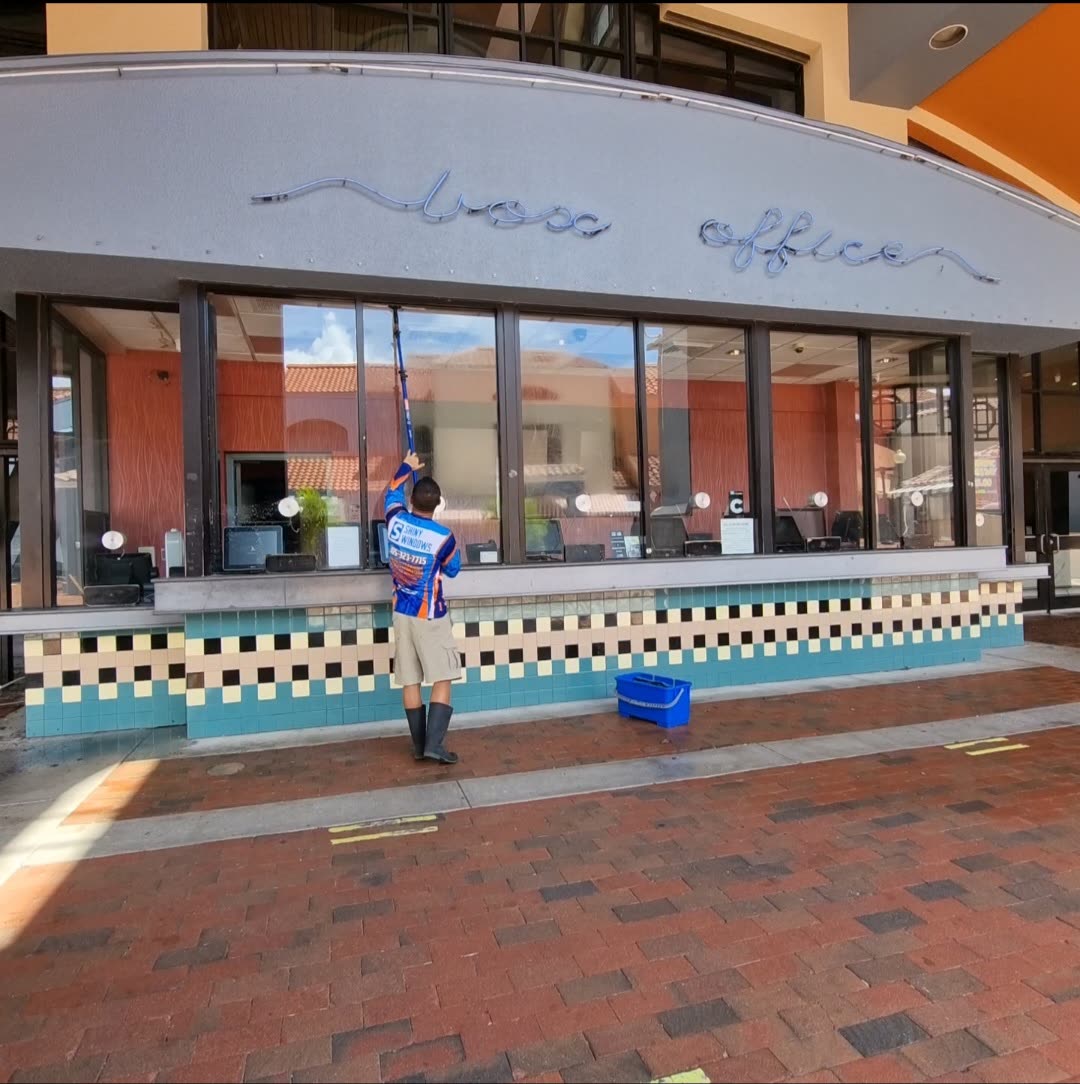
Shiny Windows reaches tall glass from the ground using a water-fed pole that goes up to 5 stories. No ladder, no climb, no risk. For high-rise commercial buildings, we use rope access with a bosun chair and proper rigging. That's where our commercial service fits. Both systems are built around safety, not improvisation. Shiny Windows carries $2 million in liability insurance, and we can provide a Certificate of Insurance to property managers, HOAs, or condo boards that ask for one.
You can replace a window. You can't replace a knee, a back, or a shoulder.
A pure-water-fed pole reaches up to 5 stories from the ground. That means zero ladders, zero climbing, and a complete clean that never touches your wall.
The equipment makes a bigger difference than most people expect
If you've ever cleaned your windows with Windex and paper towels and stepped outside two hours later to find streaks lit up by the afternoon sun, you've already met the ceiling of consumer tools. Pros don't use the same gear because the same gear doesn't get the same result.
Pure water through a water-fed pole. The water that comes out of a Miami spigot carries over 200 parts per million of dissolved minerals. Run that water through reverse osmosis (RO) and a de-ionization (DI) tank and you get water with effectively zero minerals. When zero-mineral water dries on the glass, it dries clear, no spots, no streaks, no soap residue. The full explanation is in our RO/DI water-fed pole system explainer.
Glass-safe scrapers, bronze wool, and #0000 steel wool. For the contamination that pure water can't lift on its own (paint overspray, mineral crust, dried bird droppings, hurricane prep adhesive), the right tool can scrape without scratching. Wrong tool, and the glass is permanently scratched.
Biodegradable, landscape-safe products. When a chemical is needed, what we use is non-toxic and won't burn the orchids under the window. Worth knowing if you've got pets, kids, or a yard you spent money on.
For a deeper read on why pros never use a pressure washer on glass, that one's covered in our never pressure wash your windows piece.
Clean glass is a measurable upgrade to the house
Realtors talk about "curb appeal" and they usually mean landscaping and paint. But windows are the largest reflective surface on the entire structure. From the street, dirty glass reads as deferred maintenance the same way peeling paint does. Buyers notice it. So do appraisers.
Inside, clean glass changes how a room feels. South Florida homes get sold on light. Big sliders, floor-to-ceiling glass, sunroom additions, the whole point is to bring in the view. A film of mineral haze and salt residue can cut that light by 10 to 20 percent and makes the interior feel duller than it actually is. Most homeowners don't realize how dim their place has gotten until the first cleaning, when the light comes back and the house feels new again.
What gets noticed during the visit
While I'm at the house cleaning glass, I see things. Most of the time it's small: a sprinkler head pointed the wrong way, a screen with a tear, a hairline crack in a frame, a piece of caulk lifting. Sometimes it's bigger: rotting wood under a sill, a failed seal that's starting to fog the inside of an insulated window.
You hear about it. Free. That's part of the visit.
A few things naturally pair with a window cleaning visit:
- Screen, track, and sill cleaning is included in any standard residential job. Most homeowners have never had their tracks cleaned and the difference is wild.
- Solar panel cleaning if you have a roof array. Same equipment, same pure water, same visit, you skip the second appointment. That's why we run a dedicated solar panel service.
- Post-construction cleanup if you just had work done. Stucco splatter, mortar dust, paint overspray, and adhesive residue all need pro removal anyway. That falls under our exterior service.
- Hard water stain restoration layered onto the standard clean if etching has already started. More on that in how to remove hard water stains.
What's your Saturday actually worth?
A typical three bedroom home in Doral or Coral Gables takes 6 to 8 hours of DIY window work if you're being thorough. That's moving furniture, pulling screens, cleaning tracks, two-sided cleaning on every pane, and putting it all back together. And then the streaks show up at 4 p.m. and you realize half the panes need a redo.
A pro with the right gear handles the same house in 2 to 3 hours, no streaks, no climbing, no afternoon-sun reveal. The math on time alone usually works out before you even factor in safety and equipment.
The bottom line
Hiring a professional window cleaner in South Florida isn't really about clean glass. It's about catching mineral buildup before it etches in. Spotting frame and seal damage before it turns into a leak. Staying off ladders that were never built for the job. And getting back the Saturday you'd have spent doing it the slow way.
Shiny Windows has been doing this in Miami-Dade and Broward for over 8 years. Owner-operated, $2 million in insurance, biodegradable products, water-fed pole for residential, rope access for tall commercial. If your glass looks hazy, dull, or spotted, that's the sign. Handle it now and your windows last decades longer than they would otherwise.
We service Doral, Coral Gables, Brickell, Kendall, Miami Beach, Miami Lakes, North Miami, Pinecrest, Miramar, Sunny Isles, Fort Lauderdale, and the rest of Miami-Dade and Broward.