The question every Miami homeowner eventually asks
Is it window cleaning, or is it window washing? Most clients ask us some version of the same thing: "How often should I clean my home's exterior windows?" or "When's the best time to wash my windows?" In day-to-day conversation, "window cleaning" and "window washing" are used as if they mean exactly the same thing. They don't, and once you know the difference, it gets a lot easier to ask for the service you actually want.
Let me explain in simple words, the way I'd explain it to a friend at a job site.
What window cleaning actually means
Window cleaning, in the way professionals use the term, refers to the cleaning of the glass itself. Glass and glass alone.
There are several specialties under that umbrella:
- Hard water stain removal for glass etched by sprinklers, salt spray, or mineral run-off.
- Glass polishing and restoration for older or scratched panes.
- Construction-clean to remove paint splatter, stucco, mortar, and tape adhesive after a build-out.
- Graffiti removal for storefronts and street-facing glass.
Notice the pattern. All of these target the glass surface. The traditional tools match the job: a squeegee, a strip washer, a scrim, and sometimes a glass-safe scraper. Indoor jobs and detail-heavy interior window cleaning are still mostly done this way. It's controlled, close-up, and finishes streak-free when done right.
What window washing actually means
Window washing, in our industry, is broader. It's the cleaning of the entire window assembly: glass, frame, mullions, sill, and the dust that builds up around them.
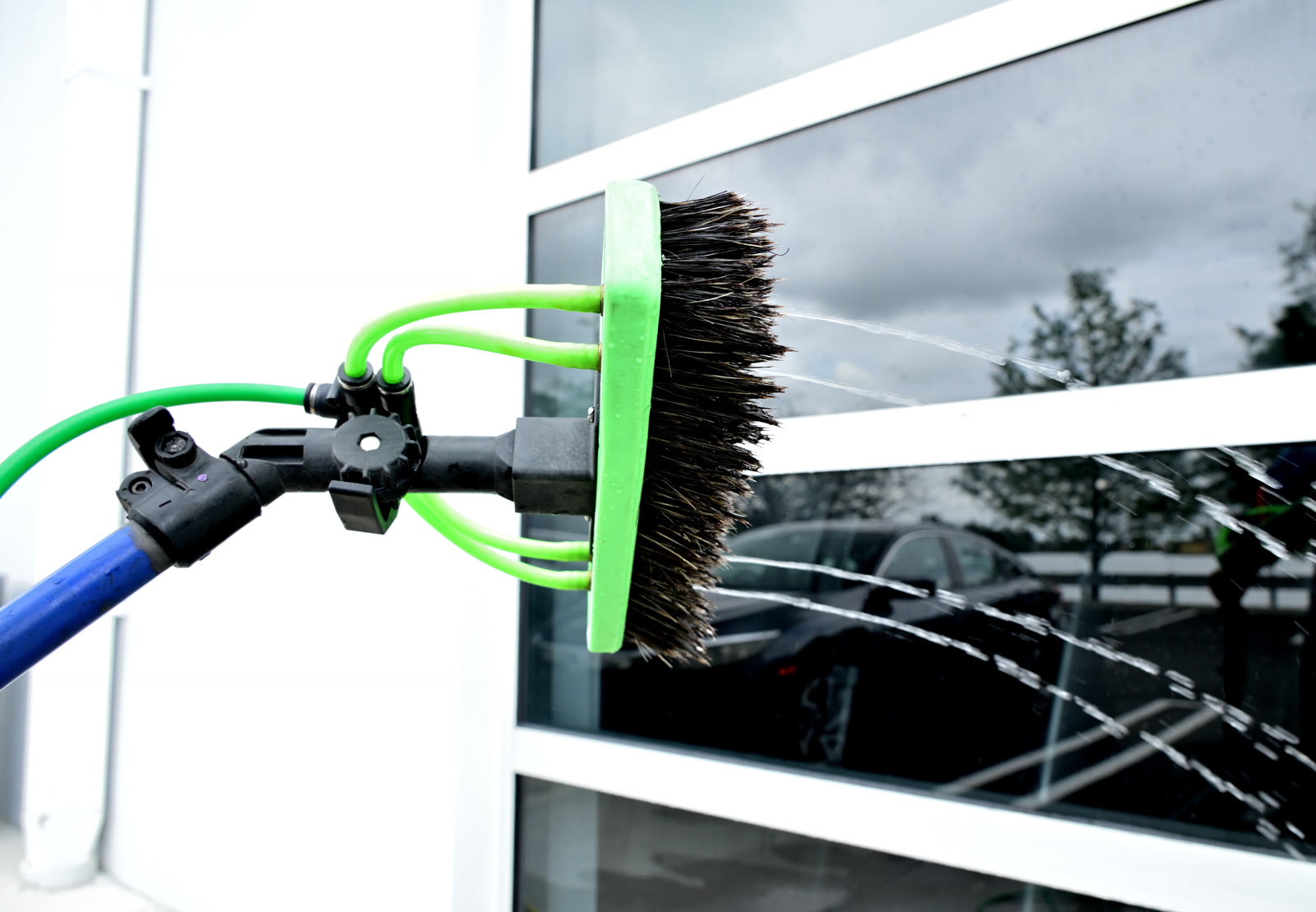
The tool that made this practical is the water-fed pole. A lightweight carbon-fiber pole carries filtered water up to a soft-bristle brush head at the top. The technician brushes the frame and glass to lift dirt and dust while the brush rinses the surface with pure water. Frames, glass, and trim all get cleaned in the same pass.
What makes the system work isn't the pole, it's the water. The water that comes out of a Miami spigot is loaded with minerals (calcium, magnesium, dissolved solids) that leave spots when they dry. To prevent that, the water on the truck runs through a multi-stage filtration setup before it ever touches your glass:
- Carbon filter to strip chlorine and organic compounds.
- RO membrane (reverse osmosis) to remove dissolved minerals.
- DI tank (de-ionization) to polish the water down to near-zero parts per million.
By the time the water reaches the brush, it's pure. No minerals, no chlorine, no residue. Pure water actively pulls dirt off the surface as it rinses. When the panes dry, they dry clear, with nothing left behind to leave a spot or a streak. If you want to see the full system in action and understand exactly why RO/DI water works the way it does, we break it down in our deeper piece on RO/DI water-fed pole systems.
Tap water in South Florida can run over 200 parts per million of dissolved solids. After RO/DI filtration, that number drops below 5. That's why the glass dries without marks.
Why this matters for Miami homes and businesses
In Miami, window washing has become the right tool for most exterior work, and it isn't just because it's faster.
- Salt air and limestone-aquifer hard water load Miami glass with minerals that traditional cleaning struggles with. Pure-water rinsing actually neutralizes the residue.
- Tall storefronts and three-story homes can be reached from the ground with a pole. No ladders against the wall, no scaffolding, no risk to people walking past.
- Frames matter. Aluminum and impact-window frames trap dust and salt spray that you only notice once it streaks down across freshly cleaned glass during the next rain. Washing the frame at the same time prevents that.
Indoor cleaning is still classic window cleaning territory. Squeegee, sill wipe-down, screen care, hand work. That's where it shines.
Which one does your home or business actually need?
Most Miami jobs are a blend of both, and a good crew will know which to use where:
- Residential interior: classic window cleaning with our residential service. Squeegees, microfiber, careful detail work.
- Residential exterior, storefronts, healthcare buildings, and multi-story exteriors: window washing with a water-fed pole and pure water. Safer, faster, and much better against Miami's salt and mineral load. This is where our exterior and commercial services fit.
- Solar panels and skylights: pure-water washing only. Anything mineral-heavy will leave a film that reduces panel output. That's the reason we run a dedicated solar panel cleaning service.
- And one tool that doesn't fit any of those categories: a pressure washer. The pressure damages seals and frames and can crack glass. We cover this in detail in why you should never pressure wash your windows.
So which word do you use?
Honestly, it doesn't matter. Call it window cleaning, call it window washing, call it "those things on my house that are dirty again." We'll figure out what your home needs and bring the right system on the truck.
If you want a free quote for either, we serve Doral, Coral Gables, Brickell, Miami Lakes, Miami Beach, North Miami, Kendall, and the rest of Miami-Dade and Broward.