What we're actually comparing
There's a customer who walks up every few weeks with the same idea: "I saw a robot on Amazon that sticks to the glass and cleans it on its own. Does that replace what you guys do?" It's a fair question and worth answering seriously rather than waving it off. Window cleaning robots are real, they work to a point, and for a small set of cases they make sense. For the average Miami home they don't.
Here's exactly what a robot like the ABIR WD10 does, where it wins, where it fails, and why most buyers shelve them after a month.
What a window cleaning robot actually is
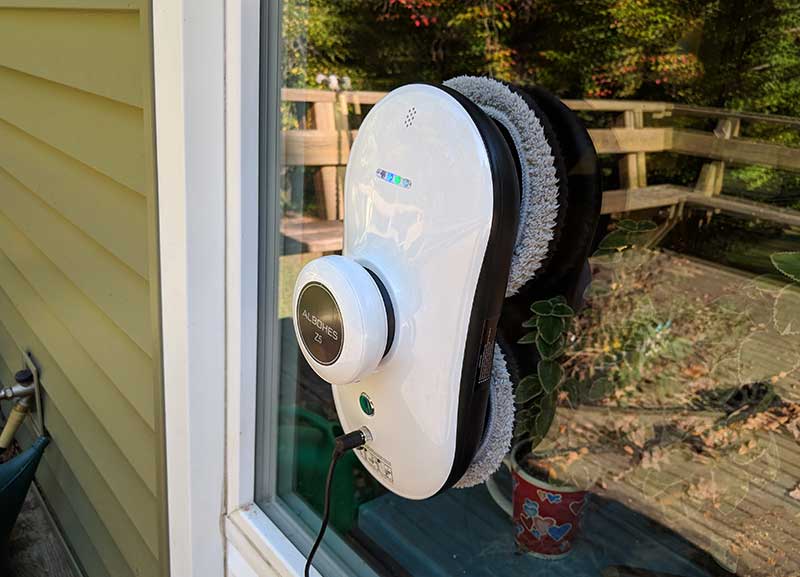
A window cleaning robot is a small square device, roughly the size of a large book, that suctions itself to the glass. It has a pair of microfiber rollers or pads on the bottom, a small water tank or atomizer, and a built-in navigation pattern for moving across the window on its own. You plug it in, turn it on, stick it to the glass, and let it run.
The ABIR WD10 is the most popular model in the budget range. For around $200 to $300 you get:
- 10000PA of suction to hold it to the glass.
- Dual roller brushes that spin to loosen dust.
- 6-way water spray that wets the glass before the pads pass over it.
- Smart navigation, usually an N-shape or zigzag pattern to cover the full pane.
- A safety rope and a 20-minute battery backup in case power fails so it won't fall.
- App and remote control to start, pause, and steer.
On paper it looks great. It competes directly with the Ecovacs and Hobot models that cost twice as much. And on a lightly soiled window, it does fine the first time you switch it on.
Where window cleaning robots genuinely do work
To be fair, there are scenarios where a robot is the right call:
- Maintenance between deep cleans. Lifting dust and finger smudges off a living-room window that's already deep-cleaned. For that, it works.
- Fixed windows on high condo floors. If you live on the 20th floor and can't reach the outside, a robot can clean the exterior from inside better than you could with a rag and a stretched arm.
- Owners with limited mobility. If climbing a ladder or stretching across a sink isn't realistic, automating light maintenance is a real win.
- Buyers who just want windows to "not look dusty." If your bar for clean is "less dirty than it was," a robot meets that.
That's the honest version. They have their place.
A robot like the ABIR WD10 takes between 4 and 8 minutes on a single mid-size window. A professional technician with a squeegee and pure water finishes the same window in under a minute, frame and all.
The toy effect: why most of them end up in a closet
Here's the part the Amazon reviews don't tell you. We talk to enough customers to see the pattern:
- They buy it excited. The box arrives, they unbox it, stick it to a window, hit start. It's fun to watch the robot crawl across the glass on its own. They film it for Instagram.
- They use it two or three times. The first few runs look decent. The big living-room windows come out presentable.
- They start noticing what it doesn't do. Corners stay marked. The frame is still dirty. The kitchen windows with airborne grease come out streaky. They have to go over it by hand anyway.
- Pad swaps get tedious. Every window or two you have to rinse or replace the microfiber pads. Refill the water tank. Charge the robot. The "automatic" part comes with 20 minutes of manual setup.
- It ends up in a closet. And stays there. When we ask during quote calls, we hear "I had one but I stopped using it" with surprising frequency.
It's not because the robot is bad. It's because the problem it claims to solve (complete, effortless cleaning) isn't the problem it actually solves (light maintenance, with effort). Once you see that, the mental switch from "this replaces a pro" to "this is a useful toy sometimes" happens fast. And for a lot of people, useful sometimes doesn't justify the closet space.
Where window cleaning robots specifically fall short
It's worth being specific instead of staying vague:
- Corners and edges. A square robot can't reach the last centimeter of the perimeter. There's almost always a frame of dust around the glass that you have to wipe by hand afterward.
- Frames, tracks, sills, screens. The robot ignores everything that isn't glass. In Miami, where salt air and construction dust load aluminum frames, that's half the job.
- cómo eliminar manchas de agua dura en ventanas.">Hard water stains. Those cloudy white blotches from sprinklers and limestone-aquifer salt do not come off with a microfiber pad and water. They need chemical treatment, patience, and sometimes a specialized polishing stone. A robot does none of that. We break it down in detail in how to remove hard water stains from windows.
- Sap, bug spots, oxidation. Same story. They need tools and know-how, not brute friction.
- One side at a time. The robot cleans the side you stick it to. To do both interior and exterior you have to detach it, carry it, and reposition. It isn't a system, it's a one-step tool.
- Streaks when the pad gets dirty. The honest reviews mention this: once the pad picks up real dirt, the robot starts spreading it instead of removing it. Because you don't swap pads between windows, quality drops as the run continues.
- Wind risk. In strong wind (not rare during Miami's hurricane season), sticking a 2-kilo device on a 14th-floor window stops feeling relaxing.
- It has no clinical eye. A human technician spots a swollen seal, early corrosion on a frame, a mold spot inside an impact-window unit. The robot just cleans and leaves. When the seal eventually fails, the repair cost is many times the price of the robot.
What a professional service does that a robot can't
To keep the comparison fair the other way, here's what a standard professional visit includes:
- Interior and exterior in the same visit, with squeegee work indoors and a pure-water-fed pole outside where appropriate.
- Frame, track, sill, and screen cleaning as a standard part of the job. Covered in our services list.
- Hard water stain treatment when needed, no extra visit charge.
- Sap, bug, and surface-oxidation removal with the right products.
- Up to three-story reach from the ground with a carbon-fiber pole. This is the real ladder replacement, not the robot. See how it works in our piece on RO/DI water-fed pole systems.
- A visual inspection of seals, frames, and hardware during every visit. We flag things before they fail.
- Streak-free guarantee. If a pane comes out marked, we come back to fix it at no charge.
- Your Saturday back. Which isn't nothing.
If you want the full breakdown of what's included and what's not in a pro service, we detail it in our piece on why hiring a professional window cleaner pays for itself.
The Miami factor
There's a reason robots look worse in South Florida than they do in, say, Denver:
- Salt air. In Miami Beach, Brickell, and any property within 3 miles of the ocean, salt floats in the air and sticks to glass and frames. A robot doesn't rinse, it just smears the wet residue around.
- Limestone-aquifer hard water. All tap water in Miami carries minerals. A robot that uses tap water in its tank leaves the same mineral residue it's trying to remove.
- Construction dust. In Doral, Brickell, and any corridor under construction, cement dust sticks to windows like light paint. That needs treatment, not a spinning brush.
- Impact windows with loaded frames. The thick aluminum frames on impact windows catch grime. If you don't wash them with the glass, the next rain streaks them down across the pane.
- servicio dedicado.">Skylights and solar panels. Inaccessible to a robot. Common on many local homes. For solar, see our dedicated service.
In drier, cleaner climates, a robot stretches further. In Miami, the environment shortens its useful life.
The honest bottom line
If you're asking honestly: should I buy a window cleaning robot or hire a pro? The answer depends on use case:
- If you live on a high floor with fixed windows you can't reach from inside and only want light maintenance between deeps: a robot can be a reasonable buy. As a supplement, not a replacement.
- If you have a typical single-family home in Doral, Kendall, Coral Gables, Miami Lakes, or a similar residential area: the robot is going to sit in a closet within six weeks. The honest math is that you'll save money and labor going straight to a professional service every 3 to 6 months.
- If you run a commercial property, storefront, or multi-story building: a robot isn't a candidate. The speed, reach, insurance, and liability coverage only come with an insured professional company.
Think of it like a Roomba. It's fine maintenance between deep cleans, but nobody actually uses it as a substitute for a mop, the truck-mounted vacuum, and the crew that actually gets the house current. Same for a window robot. Maintenance, yes. Replacement, no.
If you want to see the difference
We serve Doral, Coral Gables, Brickell, Kendall, Miami Beach, Miami Lakes, North Miami, Fort Lauderdale, and the rest of Miami-Dade and Broward. Free quote, no obligation, and most jobs schedule within 48 hours.