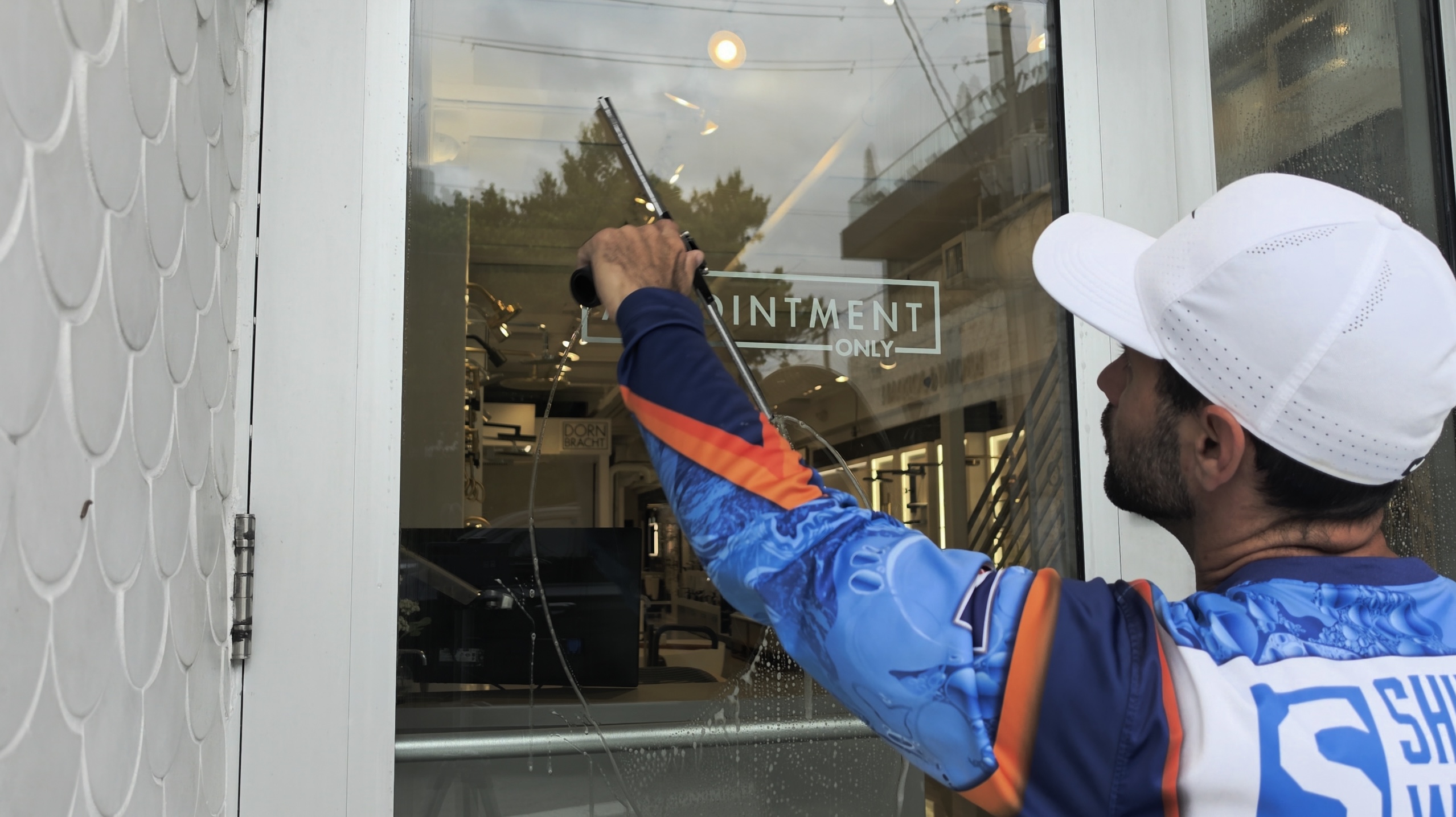
Just about everyone has cleaned a window, stepped back to admire it, and then watched streaks light up in the afternoon sun. The good news is that getting shiny, streak-free glass isn't luck or an expensive product. It's the right technique done in the right order. After 8+ years cleaning windows all over Miami, here's the method we use, what you can use at home, and what goes into a professional's water.
How to get shiny, streak-free windows
Skip the expensive chemical sprays. A simple homemade mix of water with a few drops of dish soap does most of the work, and if the glass is really grimy, a teaspoon of ammonia helps the grime release more easily and adds to the shine. The part that really matters is the technique. Follow these four steps:
- Prep the windows. Before you apply any liquid, remove loose dirt, cobwebs, and pollen from the window tracks and sills with a dry brush or a vacuum. Skip this and you'll just push grit around the glass.
- Wet and scrub. Wet a T-bar scrubber with the water and soap mix and scrub the whole pane thoroughly to break up grime, dirt, spider webs, and any mildew or salt film the glass is holding.
- Wipe and squeegee. For a flawless, professional finish, use a rubber squeegee. Start from the middle of the pane and go up to the top corner, then work down with a fanning motion from one side to the other, wiping the squeegee blade with a towel after each stroke, until you finish at the bottom or on the side.
- Buff out streaks. Grab a second, completely dry microfiber cloth and immediately buff out any leftover moisture or streaks along the edges of the glass. That's where the shine shows up.
The squeegee and the wipe-the-blade-after-each-stroke step are what separate a shiny finish from the streaks you get with paper towels. Paper towels don't remove the dirt, they just move it around the pane and leave lint behind. The squeegee actually lifts it off.
Clean your windows on a cloudy day or in the shade, never in direct sun. In the Miami sun, your solution dries on the glass before you can squeegee it off, and that's exactly what creates streaks.
What can I use to shine windows?
You don't need a name-brand glass cleaner to shine your windows. Here are the two home options that work best:
Vinegar. Whether you've run out of name-brand glass cleaner or you just want something more natural, vinegar works wonders on windows. Try a 50/50 solution of vinegar and water for a streak-free clean. You can use a spray bottle or dip a rag in the solution, just like you would an ordinary cleaner. If the smell bothers you, use vinegar only on the outside windows or mix in a couple drops of essential oil to counteract it.
Ammonia. For a different, though more chemical, smell, try a few tablespoons of ammonia in a bucket of warm water. You'll want to leave the windows open afterward to air out the smell. You can also mix small amounts of ammonia and vinegar together for even more cleaning power.
For everyday cleaning, plain water with just a few drops of dish soap also works really well and is gentle on frames and seals. Whatever solution you pick, remember: the streak-free finish comes from finishing with a squeegee or a clean microfiber cloth, not from the cleaner alone.
What do professional window cleaners use in their water?
Professional window cleaners mostly use pure, deionized water combined with a tiny drop of high-quality dish soap like Dawn, or professional-grade concentrates. That combination breaks down dirt while letting the squeegee glide smoothly. The exact mix depends on the method:
1. Pure water systems (water-fed poles). For exterior windows, many modern pros use 100 percent pure water with no soap at all. How it works: they run tap water through a portable filtration system (reverse osmosis or deionization) to strip out every mineral. Because the water is totally pure, it leaves zero spots or streaks when it dries. That pure water is then pumped up long, lightweight poles directly into a brush on the glass. We break that system down in full in our piece on the pure-water-fed pole system.
2. Traditional bucket and squeegee. For ground-level work, interior windows, or really stubborn grime, pros still use buckets. In the water they mix distilled or filtered water to avoid hard-water minerals, plus a very small amount of grease-cutting dish soap, just a few drops to a teaspoon per gallon. The soap traps the dirt and gives the lubrication the squeegee needs to glide without sticking or dragging.
Seasonal additives. In freezing weather, pros add rubbing alcohol, ethanol, or windshield washer fluid so the water won't freeze instantly on the glass. In hard-water areas, they use soaps or additives with water softeners to prevent mineral spotting, and some still add a splash of ammonia for heavier traditional cleaning.
Here in Miami, hard water from the limestone aquifer is the big one, which is why we run purified, reverse osmosis and deionization filtered water on most jobs. Once hard water has etched spots into the glass, no homemade mix will take them off. That calls for a professional hard-water stain removal treatment.
When to leave it to a pro
Doing your own windows is perfectly fine, especially the easy interior ones and touch-ups between deep cleans. Where a pro makes a real difference is on tall exterior glass, second stories that are past safe ladder reach, hard-water stains, and big panes where a single streak ruins the whole job.
Shiny Windows reaches tall glass from the ground with a pure-water-fed pole, no ladders and no risk. It's the idea behind our exterior window cleaning service and our residential service. When you want that shiny, streak-free finish without the ladder, the bucket, or the Saturday sun, that's where we come in.
Have more window cleaning questions? We've got honest answers to dozens of them on our window cleaning FAQ page. We service Doral, Coral Gables, Brickell, Kendall, Miami Beach, Miami Lakes, North Miami, Fort Lauderdale, and the rest of Miami-Dade and Broward.